Case Study

Unsafe condition reporting became real-time across multi-project sites

A large construction organization replaced supervisor-dependent reporting and manual CAPA tracking with mobile-first capture, contractor qualification workflows, and escalation-backed action closure, so risks surfaced earlier and leadership finally had cross-project visibility.

Multi-project
High subcontractor intensity
6 min read

Factory Worker with Tablet

Client Highlights

Modules: Safety Reporting, Contractor Safety, CAPA / Action Tracker, Dashboards
Use Case: Cross-project risk visibility + contractor governance
Outcome: Higher reporting volume, faster reporting, fewer overdue actions
Download PDF Case Study

Executive Summary

The Problem

  • Unsafe condition reporting relied on supervisors
  • Contractor qualification was document-heavy
  • Central leadership lacked cross-project risk visibility

What Changed

  • Mobile-first reporting for workers + supervisors
  • Digitised contractor pre-qualification + tracking
  • Executive dashboards for project-wise performance

What Improved

  • 63% increase in unsafe condition reporting
  • 48% reduction in incident reporting delay
  • 37% improvement in contractor safety compliance scores

The Challenge

1
Visibility gaps: leadership couldn’t see risk patterns across projects in real time
2
Underreporting: unsafe conditions depended on supervisor reporting, so issues stayed invisible
3
Contractor friction: qualification checks were slow and inconsistent across sites
4
Closure discipline: actions slipped because tracking lived in manual registers/spreadsheets

Context & Constraints

Number of Sites Multiple active projects
Contractor Intensity High
SOP Alignment Strict Requirement
Offline Mode Enabled for Basements

What We Implemented

Deploying a standardized, integrated safety environment across all active operational sites.

Field Safety Reporting

Configured for: Real-time capture by workers and supervisors across sites.

Key Workflow Controls

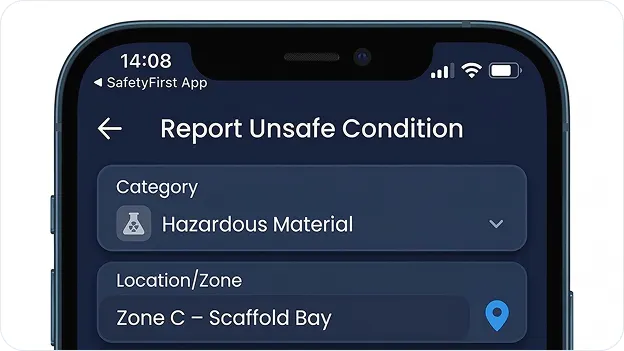
  • Guided unsafe condition templates (category, location/zone, severity)
  • Photo/voice evidence capture at source
  • Auto-routing to responsible owner (area / contractor / trade)

Audit Proof Captured

  • Time-stamped record history
  • Evidence attached inside the record

Contractors + CAPA Engine

Configured for: Predictable closure and contractor governance across projects.

Key Workflow Controls

  • Contractor pre-qualification scoring + document checks
  • Performance tracking by contractor / project
  • Action tracker with due dates + reminders

Audit Proof Captured

  • Clear ownership + due dates + escalation trail
  • Export-ready action packs (PDF/Excel)

Workflow at a Glance

1

Trigger

Worker/supervisor reports an unsafe condition on mobile with location + evidence.

2

Review

EHS validates severity and assigns the right owner (contractor / area lead).

3

Execution

Owner fixes and uploads proof (photo + notes) from the site.

4

Closure

EHS verifies closure quality (close or reopen with comments).

5

Visibility

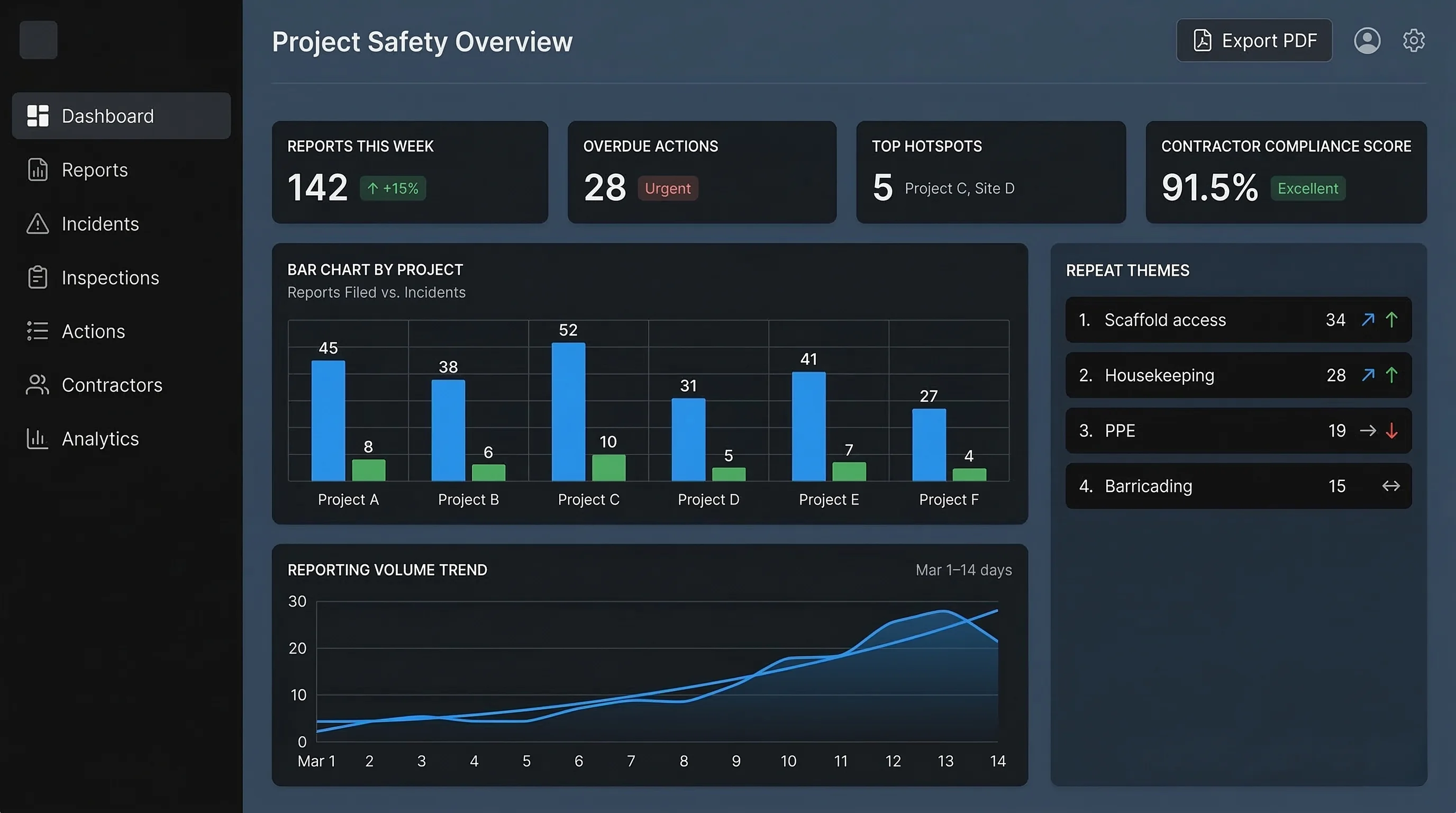
Dashboards show project-wise risk hotspots, overdue actions, repeats, and contractor performance.

Field capture view UI

Unsafe condition capture view with evidence + routing

Corporate dashboard view UI

Cross-project dashboard view (overdues, repeats, contractor scorecards)

Measured Outcomes

More reporting

63% increase in unsafe condition reporting

What Enabled It Low-friction mobile capture + guided templates

Faster reporting

48% reduction in incident reporting delay

What Enabled It On-site submission + instant routing

Fewer overdue actions

44% reduction in overdue corrective actions

What Enabled It Due dates + escalations + owner tracking

Contractor governance

37% improvement in contractor safety compliance scores

What Enabled It Pre-qualification scoring + performance tracking
Role-Based Access Control
Immutable Audit Trail
PDF/Excel Exports Available
Offline Field Capture

Ready to standardise your safety workflows?

Get the one-pager summary, or request a security brief for your IT review.

Explore similar stories

Request a tailored demo

Tell us your workflows. We’ll show your time saved.

OQSHA Demo

See OQSHA on your data, not just ours

In a 30–45 minute session, we’ll map your current safety workflows inside OQSHA and help you estimate the payoff.

  • Map one workflow live (permits / incidents / inspections)
  • Get a quick ROI estimate
  • Take a security brief back to IT

We keep your data private and only use it to schedule your demo.

Before you ask IT or procurement…

Most teams ask these questions before rolling out OQSHA.

Typically 2–6 weeks, depending on sites, workflows, and data migration. Most teams start with a pilot, then scale site-by-site.
No special hardware. Use phones or tablets for field users and a laptop or desktop with a browser for admins. Optional: QR stickers for assets.
Core workflows need internet for real-time approvals, alerts, and audit trail. Offline support can be discussed based on site constraints.
Stored securely in the cloud with encryption in transit and at rest, plus role-based access controls. Deployment options can be shared on request.
© OQSHA. All rights reserved.